We have used enough AI tools now to separate the party tricks from the useful work. Claude Code running on a server is impressive because it operates inside a real system: files, commands, tests, errors, logs, and a visible record of what changed. The model still makes mistakes, but the environment gives it something concrete to inspect and a way to prove or disprove its own work.
Construction rarely gives AI that clean an environment. A renovation project usually lives across photos, estimates, text threads, vendor calls, drawings, inspection notes, spreadsheets, emails, and someone’s memory of what was decided while standing in a crawlspace. That is normal for small operators, but it is also the reason AI in construction gets overhyped so quickly. The model can summarize the mess, and sometimes that is useful. It can also make the mess look more settled than it is.
The better question is not whether AI can draft a scope or compare two estimates. The better question is whether the project information is trustworthy enough for those outputs to help. A model working from stale assumptions, mismatched scopes, or unverified field notes can still produce a clean answer. The danger is that the clean answer may be easier to believe than the messy truth underneath it.
Change Exposes the Weak Spots
Every project has a moment when the original plan gives way to the actual house. A delivery date slips, an electrical panel cannot support the intended load, a vendor number no longer matches the work, a drainage condition expands the exterior scope, or a finish decision turns out to affect sequence. None of this is unusual. Renovation is a business of controlled adjustment.
The problem starts when the adjustment fails to reach the rest of the project. A scope item gets discussed but never makes it into the estimate. A photo documents a condition, but nobody records whether it is a repair item, a design constraint, or just something to watch. A material choice changes, while the budget and schedule continue to reflect the earlier version. By the time the conflict surfaces, the issue has moved from planning into the field, where every correction is more expensive.
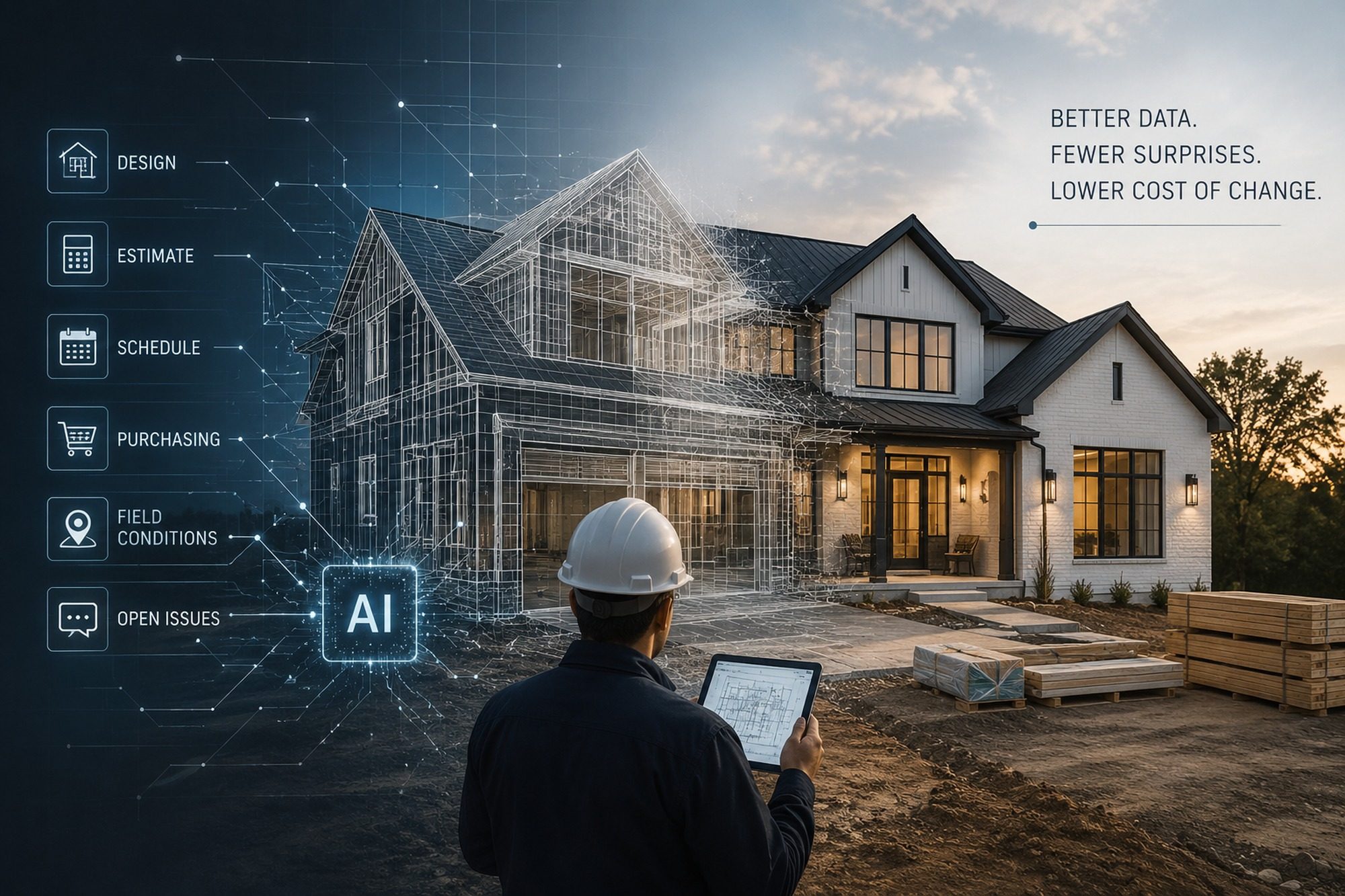
This is the useful meaning of cost of change. The edit itself may be small, but the penalty grows when the decision has to be rediscovered by each person downstream. Better project information lowers that penalty because a change carries its context with it. The field condition, the estimate, the schedule, and the next decision remain tied together.
That matters financially. NAHB’s 2024 construction cost study found that construction costs accounted for 64.4 percent of the average new-home sales price, with finished lot costs adding another 13.7 percent.1 A project with that much value tied up in execution cannot treat weak handoffs as paperwork problems. Missed scope, schedule drift, and purchasing mistakes press directly on the deal.
A File Is Not a Source of Truth
Construction people use the phrase “source of truth” because the need is obvious. The phrase gets abused because the hard part is not naming the folder. A source of truth has to carry decisions forward. If the current plan, the estimate, the field notes, and the material assumptions do not agree, the project has several partial truths competing with each other.
The same issue shows up at a larger scale in production building. One IBS 2025 education session on automated takeoffs, predictive scheduling, and supply-chain forecasting described workflows built around takeoff accuracy, schedule conflict detection, procurement forecasting, and data requirements.2 That framing is useful because it treats AI as dependent on the underlying project structure. A forecast needs dependable inputs. A predictive schedule needs real constraints. A takeoff is only valuable if it reflects the version of the work actually being built.
Small renovation companies do not need the same software stack as a regional production builder, but the operating principle is similar. The project needs a place where decisions become usable. The photo of the subfloor needs context. The electrical constraint needs to connect to the appliance plan. The vendor proposal needs to be tied to the scope it priced. The open question needs to remain visible until it is answered.
Without that discipline, AI becomes a formatter. It can turn fragments into fluent prose, which is useful for communication and dangerous for decision-making. A weak assumption with better grammar is still a weak assumption.
Renovation Makes the Inputs Messier
Production building has repetition. Renovation has discovery. Older Bay Area houses often bring sloped sites, tight access, old framing, drainage problems, undersized panels, and prior work from several eras. The relevant facts may not appear until demolition, inspection, or a deeper look at the site. That makes the information problem harder, because the project has to keep track of both verified conditions and working assumptions.
This is where a lot of AI talk in construction gets too smooth. It treats the project as if the main problem is generating an output. In renovation, the harder problem is knowing what the output should be based on. The house changes the plan as it reveals itself. A good system has to record those discoveries clearly enough that the next estimate, schedule decision, or vendor conversation reflects the current reality.
AI can help once that record exists. It can compare two bids against the same scope. It can turn a site walk into a usable summary. It can help prepare a punch list from photos with notes attached. It can search old project records for similar conditions. These are practical uses because they work from captured information. They do not require pretending the house is cleaner or more repeatable than it is.
The discipline comes first. The tool comes after.
Most Builders Are Still Using AI at the Edge
The current pattern of AI adoption supports some skepticism. NAHB reported in 2025 that single-family builders were using AI most often for advertising and marketing materials, at about 20 percent, and for market analysis or future project planning, at about 11 percent. Fewer than 5 percent reported using AI across ten other business functions, including project design and automated construction equipment.3
That is not surprising. Marketing can tolerate fuzziness. Construction operations cannot. A slightly bland listing caption is forgettable. A wrong assumption in a takeoff or schedule can cost real money. Builders are moving more slowly where the consequences are higher, and that caution is rational.
There is also a broader productivity problem in the industry. McKinsey has argued that construction faces a growing output challenge without faster productivity improvement, with fragmentation and slow adoption of better operating practices among the recurring obstacles.4 AI may become part of the answer, but only where it improves the flow of information through the work. Adding another tool to an already fragmented process can just create a new place for the project to drift out of sync.
Other industry surveys point in the same direction. Home Innovation Research Labs reported that awareness of AI use among builders increased from 20 percent in 2024 to 32 percent in 2025, with design and planning becoming a leading reported use case.5 That is meaningful, but it also raises the standard. Design and planning are exactly where confident-looking outputs need careful checking against scope, code, cost, lead time, and field reality.
Oakmore’s View
AI is useful when it improves project memory. It is useful when it helps compare assumptions, find missing decisions, preserve field context, and make a change easier to trace. It is useful when it helps a small team keep the current version of the project visible.
The attraction is not novelty. The attraction is fewer decisions lost between the site, the estimate, and the work. In an old house, a missed assumption can travel a long way before anyone notices. Better notes, better structure, and better search can prevent some of that. AI can strengthen those habits if the information behind it is worth trusting.
The risk is treating the output as proof. Construction already has enough documents that look more complete than the project actually is. AI can produce more of them quickly. The operator still has to know what was verified, what changed, what remains uncertain, and which decision carries cost or schedule risk.
For Oakmore, the useful version of AI starts with better project information. Scope, field notes, estimates, photos, vendor numbers, and open questions have to be organized well enough that the tool has something real to work from. Once that exists, AI can help reduce the cost of change. Without it, the model is only guessing in a better font.
Sources
-
National Association of Home Builders, "Cost of Constructing a Home in 2024." https://www.nahb.org/news-and-economics/housing-economics-plus/special-studies/special-studies-pages/cost-of-constructing-a-home-in-2024 ↩
-
NAHB International Builders' Show, "Automated Takeoffs, Predictive Scheduling & Supply-Chain Forecasting with AI." https://www.buildersshow.com/Search/EducationSession.aspx?id=3239278 ↩
-
NAHB, "AI in Home Building: Still in Its Infancy, But Gaining Ground." https://www.nahb.org/blog/2025/08/ai-in-home-building-gaining-ground ↩
-
McKinsey & Company, "Delivering on Construction Productivity Is No Longer Optional." https://www.mckinsey.com/capabilities/operations/our-insights/delivering-on-construction-productivity-is-no-longer-optional ↩
-
Home Innovation Research Labs, "AI Adoption Increases Among U.S. Home Builders." https://www.homeinnovation.com/insights/trends_data/ai-adoption-increases-among-us-home-builders/45868 ↩